Auto News
AutoGuide News Blog
The AutoGuide News Blog is your source for breaking stories from the auto industry. Delivering news immediately, the AutoGuide Blog is constantly updated with the latest information, photos and video from manufacturers, auto shows, the aftermarket and professional racing.

tata-nano-ev-05.jpg

Despite competition from Tata, known for building the world’s cheapest car, Suzuki has no plans to compete head-to-head with the Indian automaker. Currently Suzuki has a stranglehold on emerging markets like India, but Tata is looking to take a chunk of that with the Nano, which undercuts the already inexpensive Suzuki models.

Slamming the Indian-made Nano, Suzuki boss Osamu Suzuki said that building an even lower model vehicle is not a part of the company’s plans as it, “wouldn’t be a car anymore.”

The main reason that Suzuki is letting Tata have the lower end of the market is that it feels an even lower model would devalue the brand. The Japanese automaker cites concerns that such a model would require reduced safety and comfort, two areas where it’s not prepared to perform cuts.

[Source: AutoCar]

tata-nano-ev-05.jpg

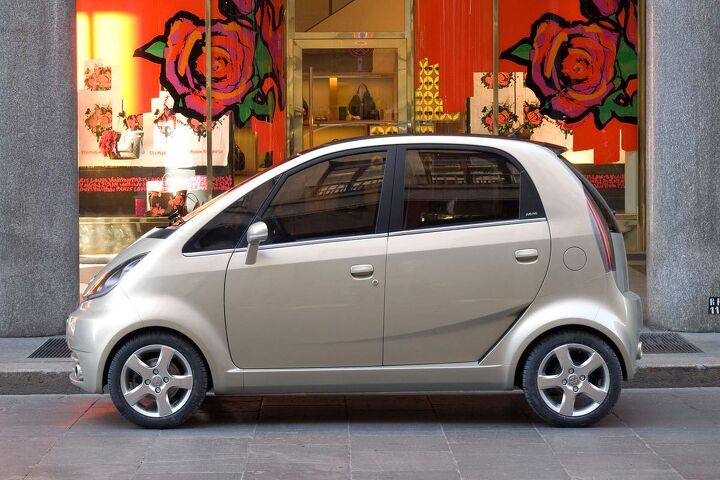
Tata unveiled a new electric version of its Nano at the Geneva Auto Show. The Nano EV joins the Indica Vista EV in Tata’s electric line-up.

The Nano EV will use the same super polymer lithium-ion battery as the Indica Vista EV. The electric version of the world’s least expensive automobile has a range of 99.4 miles, short of the Indica Vista EV’s 124-mile range, which is unusual considering the Indica Vista is a larger vehicle.

The Tata Nano EV will make its way to European markets in 2010 with expansion to other markets coming later.

Gallery: Tata Nano EV

tata-nano-ev-07.jpgtata-nano-ev-01.jpgtata-nano-ev-04.jpgtata-nano-ev-03.jpgtata-nano-ev-06.jpgtata-nano-ev-02.jpg

IMG_5008.JPG

The first details on Indian automaker Tata’s Nana Europa model have been announced, giving us a closer idea of what the car might be like when it arrives in the U.S. in 2012. Famous for being the world’s cheapest car, the Nano sells for $2,000 in India, but the European model will cost far more than that at around $6,500 to $8,000 (£4000 – £5000) due to safety upgrades, creature comforts and a more powerful engine.

The body of the car is made entirely of steel, with a length of 3300mm or 130-inches. By comparison the Smart fortwo is 106-inches long – or two feet shorter than the Nano. Under the hood there’s a 1.0-liter 3-cylinder engine making 60-hp, up from the 35-hp unit used in India. A five-speed manual transmission is standard – an upgrade from the 4-speed unit in India.

Impressively it gets a fully-independent front and rear suspension, as well as ABS, traction control, electric power steering and two airbags.

The Nano Europa is expected to go on sale in Europe in 2011, with scheduled sales in the U.S. in 2012. Pricing in the U.S. is expected to be at or below $8,000.

GALLERY: Tata Nano Europa Concept Debut in Geneva

IMG_5007.JPGIMG_5008.JPGIMG_5009.JPGIMG_5010.JPGIMG_5011.JPGIMG_5006.JPG

[Source: Autocar]

halewood_frontage_2_88da_1143.jpg

Jaguar Land Rover owner Tata Motorsw says it will close either a Jaguar or Land Rover factory in England by 2014. The decision as to which of the company’s three U.K. plants will be shuddered has not yet been made, but Tata has said which two are on the chopping block.

The first candidate is the Jaguar facility in Castle Bromwich and the second is a Land Rover facility in Solihull. The plan is to consolidate the two facilities over the next five years, with a decision being made in the next 12 to 18 months. Currently JLR (Jaguar Land Rover) employs 5,000 staff in Solihull, 2,000 in Castle Bromwich and 1,800 at the Halewood plant (pictured above) in northwestern England. There is no word on how many jobs will be cut, but Tata did say that800 additional jobs will be created in Halewood when production starts on a new small crossover based on the LRX Concept.

JLR suffered considerable losses during the recent economic downturn, with reduced demand meaning that JLR production facilities were only working at 60 percent capacity. So far, in order to meet the decreased demand the automaker has cut production by over 100,000 units while cutting 25,000 jobs.

[Source: Automotive News]

jaguar_xj_09_usa_d41f.jpg

Jaguar Land Rover’s (JLR) new Indian owner Tata Motors continues to invest in and makes plans for its newly acquired luxury division despite what has so far been a very poor return on investment.

JLR posted a $1.11 billion loss last year but that won’t stop Tata from making big changes, the first of which is an initiative to reduce the weight of all new vehicles.

JLR is planning to have all its future cars constructed with light weight aluminum bodies resulting in considerable savings in weight and reduction in CO2 emissions,” said CEO Ratan Tata in his company’s annual report. Weight is certainly something Land Rovers could lose, as some models are currently approaching the 6,000 lb mark.

Jaguar’s new 2010 XJ (pictured above) not only makes use of aluminum body panels but an all aluminum frame and is the first of a new line of Jaguars to be launched by Tata. The lighter package requires a less powerful (and more fuel-efficient) engine, as well as smaller and less expensive brakes to stop.

Considering the massive weight of Ranger Rovers and the significant surface area that their sheet metal has to cover, an aluminum body would make a noticeable difference. [Source: Motoemag]

IMG_5627.JPG

The acquisition of Jaguar Land Rover (JLR) by Tata Motors Ltd. from Ford continues to hurt the Indian automaker as the two British brands recorded a combined net loss of $1.11 billion in 2008.

As a sign of the troubled economic times, in 2007 the two automakers managed a total net profit of roughly one billion dollars.

Tata has worked hard to cut costs across the board and has introduced several new models which it hopes will boost sales, especially now that the auto-sector (and the economy) seems poised for recovery. New models include the significantly revised 2010 Range Rover and Range Rover Sport as well as the LR4 (pictured above). And in the Jaguar division JLR recently lunched a new flagship XJ, which leaves behind the traditional Jaguar design for a more broad-based look that the automaker hopes will help it compete with higher-volume German rivals.

In order to keep operations running in the short term Tata is currently working out a loan agreement with the British government, the value of which is reportedly worth around $290 million. The money is all but guaranteed, however, the British government would like a short 6-month term to re-pay the loan, whereas Tata is asking for 12 months. The British government is also seeking a spot on Tata’s board, to ensure its money is being spent wisely.

[Source: Automotive News]

IMG_5619.JPG

Tata Motors has posted its first annual loss in eight years due to a significant drop in demand for vehicles from its newly acquired Jaguar Land Rover (JLR) unit. The Indian automaker, also known for manufacturing the world’s cheapest car (the Nano), posted a net loss of $520 million for its 2009 fiscal year, with a $504 million loss at JLR.

In the 10 months since Tata bought JLR from Ford Motor Co., the division moved just 167,000 units – compared to 246,000 units during the same 10 month period the year before.

Tata’s Vice Chairman Ravi Kant told a news conference that the automaker was continuing to search for ways to cut costs and he did not rule out job cuts and plant closures.

Tata’s fiscal calendar ended at the start of March, and Tata says JLR has posted better numbers since then.

[Source: Reuters]

IMG_5010.JPG

Indian automaker Tata has confirmed that it will bring the Nano to the U.S. in the next three years. The Nano, launched officially several months ago in India, holds the title of being the world’s cheapest car with base models priced at just $2,000.

David Good, a U.S. representative for the Indian automaker, which also owns Jaguar and Land Rover, confirmed statements made by company CEO Ratan Tata at Cornell University earlier this week.

“It might be two years and six months,” Good said in an interview with Automotive News.

Powered by a 624cc 2-cylinder engine that makes just 35hp, the Nano comes with a 4-speed gearbox with full power available at 5250 rpm and full torque (35 ft-lbs) on tap at 3000 rpm. Tata claims an average  fuel-economy rating of 55.5 mpg according to the Automotive Research Association of India (ARAI), giving it the highest rating of any gasoline car in India.

The Nano is also tiny, measuring just 10.2-feet long, by 4.9-feet wide and 5.3-feet high.

The Nano “will meet all emissions and crash standards,” Tata said. The current model for India features a reinforced passenger compartment, crumple zones, intrusion resistant doors, as well as the mandatory seat belts.

Tata also plans to bring a version of the Nano to Europe in 2011.

[Source: Automotive News]

3_4_Front_view01.jpg

Well, here’s an exciting follow-up to yesterday’s story about the launch of the new Tata Nano in India; Tata is looking to bring the $2,000 Nano to the U.S.

According to a report in the Financial Times, Tata boss Ratan Tata is hoping to take advantage of the worldwide recession by bringing affordable (and we mean REALLY affordable) cars to markets worldwide, including North America.

Tata told the Times that this decision is a serious one and that no one at the company is taking the possibility of expansion into the U.S. lightly. “The US is very unforgiving of mistakes,” he said.

As for meeting strict U.S. emissions and safety requirements, that actually shouldn’t be too difficult as Tata has already announced that it plans to sell the Nano in Europe in 2011.

That year could also be the first year of U.S. Nano sales.

As for the car itself, the Nano is powered by a 624cc 2-cylinder engine that makes just 35hp and 35 ft-lbs of torque. Tata claims an average  fuel-economy rating of 55.5 mpg according to the Automotive Research Association of India (ARAI), giving it the highest rating of any gasoline car in India.

The car is tiny, just 10.2-feet long, 4.9-feet wide and 5.3-feet high, giving it the smallest dimensions of any vehicle on the road in India. It is, however, 21 percent more spacious inside than the current smallest car.

Despite the size, Tata insists the Nano is very safe due to a reinforced passenger compartment, crumple zones, intrusion resistant doors, as well as the mandatory seat belts. The Nano exceeds all safety requirements in India and even passes a roll-over test and offset impact test which are not required.

Tata did not release any info on what U.S. pricing would be, but it is expected to be significantly higher than the base $2,000 price, as base models in India come without heat or air conditioning.

[Source: FinancialTimes]

Tata Nano Goes On Sale In India For Just $2,000

Base models come without heat or air conditioning

Nano_Basic_and_Luxury.jpg

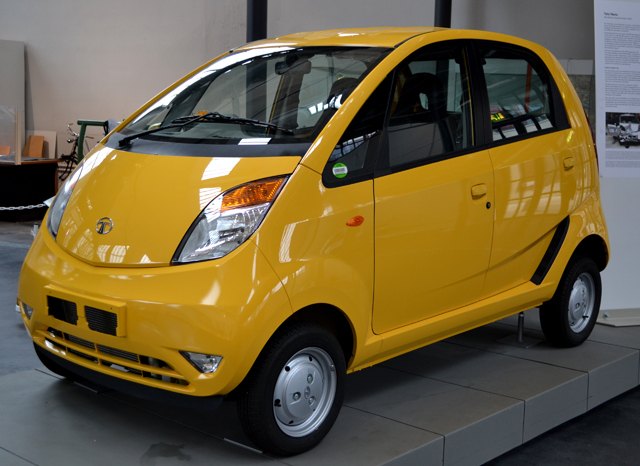
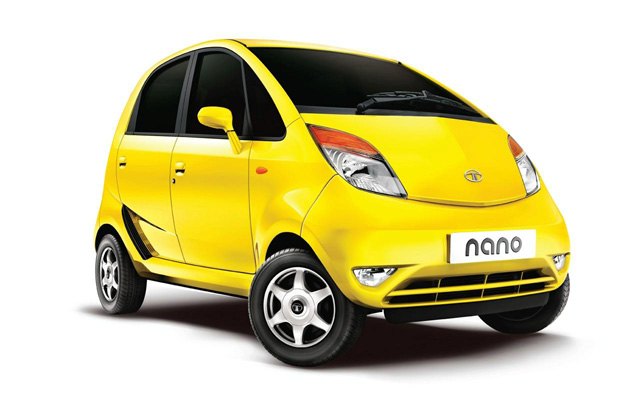
Yesterday in Mumbai, India Tata Motors officially launched its revolutionary Nano micro-car. Powered by a 624cc 2-cylinder engine that makes just 35hp, the Nano will be offered in three trims levels with a starting price of just $2,000.

The Nano comes with a 4-speed gearbox with full power available at 5250 rpm and full torque (35 ft-lbs) on tap at 3000 rpm. Tata claims an average  fuel-economy rating of 55.5 mpg according to the Automotive Research Association of India (ARAI), giving it the highest rating of any gasoline car in India.

The car is tiny, just 10.2-feet long, 4.9-feet wide and 5.3-feet high, giving it the smallest dimensions of any vehicle on the road in India. It is, however, 21 percent more spacious inside than the current smallest car.

Despite the size, Tata insists the Nano is very safe due to a reinforced passenger compartment, crumple zones, intrusion resistant doors, as well as the mandatory seat belts. The Nano exceeds all safety requirements in India and even passes a roll-over test and offset impact test which are not required.

In terms of the trim levels offered, customers can opt for either the Standard, CX or LX models. The Standard model is as bare-bones as possible, with three color options and a fold down rear seat. Upgrading to the CX model brings two additional colors as well as power-assisted brakes, heating and air conditioning (a must for most of India).

As fort the top-line LX model, it comes with everything in the CX as well as power windows, three premium paint colors, fog lights, a trip meter, a spoiler and even a cup holder.

As for a warranty, Tata gives the Nano a standard 18 month/24,000 km warranty.

“The Nano represents the spirit of breaking conventional barriers,” said Tata Chairman Mr. Ratan N. Tata. “From the drawing board to its commercial launch, the concept, development and productionisation of the car has overcome several challenges. It is to the credit of the team at Tata Motors that a car once thought impossible by the world is now a reality. I hope it will provide safe, affordable, four-wheel transportation to families who till now have not been able to own a car. We are delighted in presenting the Tata Nano to India and the world.”

There is no word on expected production numbers, but Tata is currently building a new manufacturing facility with an estimated annual output of 350,000 cars.

GALLERY: Tata Nano

Nano_Luxury_interior.jpg3_4_Front_view01.jpg3_4_Rear_view02.jpg


More on the Tata Nano after the jump: